Search This Blog

Showing posts with label government. Show all posts

Saturday, July 12, 2025

"Look what they're doing!"

What are the current aims of the administration in our nation's capital, and what was your first clue? How about this? Anything you hear them accusing their opposition of doing is exactly what they are doing.


"Rig" an Election? The 2020 election was run and won fair and square, but can the same be said of the 2024 election? Certain remarks made by the president raise doubts. "Rigged" if you lose, not if you win? Hmmm....


"Weaponize"? Yep, that's just what the current administration and its Congressional supporters are doing. An impartial justice system, one that would punish those who break the law, is not what those determined to abolish laws desire. Hence the epidemic of "firings" (purging would be a more accurate term) of long-time government employees loyal to the Constitution and the laws of the land. 


"Witch hunt"? Again, yes! Those petulant whining and cryings from the White House about "witch hunts" are another instance of accusing your opposition of exactly what you are doing. Ever criticize the current president? Ever disagree with him on anything? And if you are a Democrat--well, that speaks for itself! "Out with the witches!" is the Republican yell today.


[Note: Republicans, not Conservatives. It is not conservative to undermine the rule of law and abandon the nation's ideals.]


"Hate"? No, the opposition to the administration does not "hate" America! Far from it! We love our country and its ideals, and if we hate anything it is the current authoritarian agenda that is dragging us into the mud and would throw those ideals out the window. But just listen to the spewing from the hater-in-chief! Accusing, blaming, name-calling. Plenty of hate in that quarter.


The psychological term for accusing the other guy of what you yourself are doing is projection. In the world of psychology, the finger-pointer is not consciously aware of what he is doing, but can the same be said of Republican finger-pointers today? In a few cases, perhaps, but I am more inclined to think it is, in general, a very conscious, intentional strategy, a pre-emptive move designed precisely to put the opposition on the defensive. I guess you might call it smart. I call it evil.


Thursday, February 6, 2025

Please Stop Using That Word!


One summer on Nagonaba Street....

What do the dictionaries say about the meaning of the term ‘conservative’?


The American Heritage Dictionary says it means “favoring traditional views and values; tending to oppose change.” 


Merriam-Webster defines it as “tending to favor established ideas, conditions, or institutions. 


Oxford Languages (a new “brand” under whose umbrella resides the Oxford English Dictionary, it seems) defines the adjective ‘conservative’ as follows: “averse to change or holding traditional values.” (And now I cannot find that page again online.)


The Cambridge English Dictionary describes the same word as meaning “not usually liking or trusting change, especially sudden change.”  


Britannica calls ‘conservatism’ this way: “a political doctrine that emphasizes the value of traditional institutions and practices.” 


How many “principles” of political conservatism are recognized in the U.S. Some say five, some seven, others ten. It depends on your source. Congressman Mike Johnson, present Speaker of the U.S. House of Representatives, who claims to be a conservative, cites seven “core principles,” and let’s take him at his word, since he is the Speaker. Those principles are, he says: 


1. Individual freedom

2. Limited government

3. The rule of law

4. Peace through strength

5. Fiscal responsibility

6. Free markets

7. Human dignity


In your opinion, how does the current Republican administration in Washington stack up on these core principles, taken one by one?


As for the more general term, I do not see the present administration’s scorched earth raids on government as “favoring traditional values,” “favoring established institutions,” or “opposing sudden change.” There is nothing conservative about filling the most important Cabinet positions with loyalists (most of them unqualified, even unfit for office; many guilty of all manner of crimes and ethics violations) who see their mission as eliminating the very departments they are appointed to oversee. There is nothing conservative about handing the keys to government over to an unelected billionaire (an immigrant, therefore ineligible to be president himself) and his hastily assembled “team” of young, inexperienced tech nerds. And there is nothing conservative about the Supreme Court of the land deciding that the man in the Oval Office is above the law. None of this is conservatism. A coup d'état is by its very definition anything but conservative.


So if what's going on in our nation these days isn't conservatism, what is it? Perhaps anarcho-capitalism comes closest. What a dream come true that is for billionaires frustrated that none of them yet controls all the world’s wealth!  Someone else suggests technofascism for what is planned and will shortly be executed if not stopped. Question: Are anarchism and fascism contradictory? An answer to that would depend, I guess, on how one regards law.


P.S. Don't lose heart!


Tuesday, August 20, 2024

Stop Falling for the Either/Or Crap!

...Or so some people would have you believe....

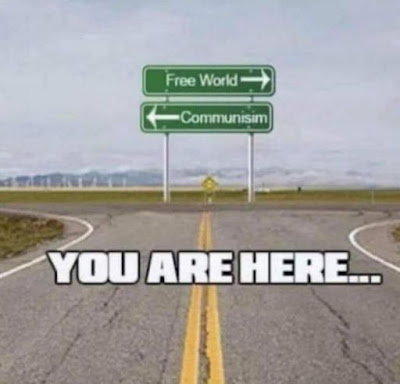
It doesn’t make good sense to trust every aspect of life to government – any kind of government. Communism only turns into another kind of oligarchy, with party leaders on top taking the place of landed gentry and everyone else relegated to a peasant/worker class with few important rights. --But neither does it make good sense to trust every aspect of life to unregulated market forces. There are essentials in life, both biological and social, much too important to be left to unrestrained market forces. The only kind of economic “system” that makes sense is a mixed economy, with roles both for entrepreneurial markets, regulated where necessary, and government-run public institutions.


Note that I do not use the term “free market” for the ubiquitous either/or false dilemma so often posed. Why? Because what is meant by “free” when applied to market forces just is lack of regulation. We are asked to allow business to be as free as the wind, and if it whirls itself into a tornado or whips up a tsunami and destroys human lives in its path, well, we are told, that’s the price of “freedom.” No. I say no. That is the price of self-deception on the part of Americans who have bought into a dangerous theoretical fiction unleashed on the world by Milton Friedmann and confusing and destroying communities for decades.


Economists are theoreticians. I find it bitterly ironic that so many people who consider themselves “conservative” will reject evolution because it is a “only a theory” and then turn around and embrace an economic theory which has far less evidence for itself. And yet the untrammeled theoretical “free market” has become an article of faith for American conservatives, a plank almost religious (to judge by the fervor with which it is held), and certainly a litmus test for politicians, so that if a candidate voices the slightest support for any kind of regulation, that candidate is branded “socialist” or even “communist,” and conservatives run in fear, believing their “freedom” is in danger.


Bullshit! If all aspects of health, education, and banking were to be treated exclusively as unregulated businesses, with clinics, hospitals, schools, and investment groups run solely for profit and without any boundaries on their greed, the rights of American citizens to speak and organize and vote would count for very little. You don’t trust “government,” but you trust “corporations”? Really? With your life?


Would you do away with public libraries, public schools, public boards of health, and replace all of them with for-profit businesses, available only to paid subscribers, like cable TV? Would you close the government mint and throw American citizens on the stormy, uncertain seas of myriad “crypto-currencies” (digital “currencies” 100% dependent on huge, monster computers, with their huge, monster fans running 24/7 somewhere off in the countryside), an untested monetary abstraction that few even pretend to understand? 


A simpler example: A certain faction of our country seeks to “privatize” (i.e., sell to profit-seekers) the United States Postal Service, replacing it with anyone in the market who wanted to start up a company but would have no mandate to serve the entire country. Profitable areas could be cherry-picked, the rest underserved or not served at all. 


And note carefully here that “privatization” means more than letting business instead of government run something: it means selling off carefully constructed public goods that have been built and maintained for years with money from public taxes – not to those who paid the taxes for years (often generations) but to a private, profit-seeking organization or organizations. [Note: The United States Postal Service was government-funded until 1970. Since then, like county conservation district offices, it has had to pay its own way in the country, competing against private companies who do not have to serve every community.] Historic public good sold at fire sale prices? How can that be for the benefit of the public? How does that increase the “freedom” of citizens?


Those who would blind you with the false dilemma “socialism vs. freedom” rely on your not seeing that unrestricted “freedom” for corporate “persons” means seriously diminished real freedom for real persons, i.e., human beings. No one can own the air, and it cannot be restricted to a bounded place, so why should a corporation be allowed to poison it in order to make profits, and how does sacrificing environmental and human health to market forces increase our freedom? It does not. That is only one example.


I don't even want to say there are many shades of grey between black and white, and the idea of heads or tails on a coin is plain silly. It makes more sense and is truer to life to think of alternatives to either/or as a rainbow of possibilities.


The "road" of the future does not exist until we build it -- and in my imagination it is not one big superhighway but an interconnected network. Again, possibilities....


False dilemmas - Homework: Think about it. 


Tuesday, December 17, 2019

Je l'accuse!

If there is one single individual I hold primarily responsible for Congressional gridlock and the awful, yawning chasm of partisanship that divides our country today, for the deterioration of political civility and the abandonment of Constitutional duty by elected officials, that person is Mitch McConnell. I know many of my friends would give the current president shame (not honor) of first place in such a contest, but I see things differently. The current president would never have been a candidate had the divide not been already so deep. And even elected to the highest office, he could never single-handedly have achieved the levels of destruction we have seen without a Republican party united behind him, united for the sake of their party rather than the country, led in the U.S. Senate by Mitch McConnell. 

McConnell’s reprehensible and indefensible machinations began long before the current administration was in place. Never in my life (there may have been instances in history but never as long as I have been alive) has there been such disrespect for a sitting president as McConnell showed President Obama. Others in his party and in the Senate fell in line, but McConnell was the ringleader. Anything President Obama proposed, McConnell was against, not because any particular proposal was against his “principles” but simply because Obama proposed it. He made it plain from the very beginning of the Obama administration that he did not intend to let the president have a single “win” on anything, and the shameful culmination of this campaign of partisan Congressional dereliction of duty came when the Senate refused to hold hearings for Obama’s nominee for the Supreme Court, Merrick Garland, a moderate admired by Republicans as well as Democrats. Blocking those hearings was an egregious slap in the face to the president, and I call it a dereliction of the Senator’s duty under the Constitution, as well as a mark of disrespect I have yet to manage to forgive.

Now that there is a putative Republican in the Oval Office, McConnell has generally continued his lockstep partisan strategy, putting party ideology over ideals, principle, and even Constitutional duty. To bring civility back into our national discourse, we need to get rid of uncivil, power-hungry partisan ideologues in government and replace them with men and women of decency and dignity who will fulfill the duties of the offices to which they are elected.

Robert Reich has written a piece asking who is worse, Trump or McConnell, something I read it this morning while searching online for other opinions on the Senate Majority Leader. As I see it, the president is the Great Oz, a little man behind the curtain. McConnell is the curtain.

Tuesday, November 12, 2019

A Great President

James Earl Carter, thirty-ninth president of the United States of America, has too often been called our best former president though a bad, i.e., ineffective president while in office. I wish to differ.

War and Peace

Our country was not at war during the four years of the Carter presidency. Stop and reflect on that for a moment. As commander-in-chief, President Carter called for the sacrifice of no American’s life.

And yet, at the same time, without military action and through diplomatic efforts alone, he was able to bring about the beginnings of peace in the Middle East, a hard-won dream still to be fully realized. Carter’s intelligence, information, preparation, and patience were all at work at Camp David.

Energy and Environment

He took the long view on environmental issues and set us on a path of energy conservation and independence. President Reagan reversed that direction, and no American president since Jimmy Carter has been clear-sighted or determined enough to put us back on track.


Transparency

When President Carter held a press conference, he made every attempt to answer questions clearly and directly. I will never forget my astonishment the first one I watched him give a televised press conference. Has there ever  — in your lifetime — been a president more honest with the American people?


Crisis

Despite the taking and holding of hostages that guaranteed his bid for reelection would be defeated, ultimately the hostages came home alive, in large part because Jimmy Carter put a higher priority on the hostage situation than on campaigning for reelection.


Decency

That James Earl Carter has always been a decent, honorable man no one can deny. A naive visitor from another planet, looking at the burdens and responsibilities of leadership, might assume decency to be a minimum requirement for the presidency of the United States. History and experience, however, paint a very different picture, and decency is often mentioned as if it can only be, if not the opposite of greatness, yet a kind of honorable mention granted to someone who failed to achieve a place in the pantheon of greatness.  


Vision

The long partnership of Jimmy and Rosalyn Carter, the work of the Carter Center in Africa, the Carters’ hands-on volunteering with Habitat for Humanity — all those would attest to lives well lived, had the couple never lived in the White House. And yet I would have Jimmy Carter admired and revered not only for his basic decency and his charitable work and the teaching of Sunday school but for the vision that, as President Carter, he brought to the nation and the world. 


I feel privileged to have lived in an era that saw both Jimmy Carter and Barack Obama elected to the nation’s highest office. The true legacy of both men rests not on mere legislation (which subsequent leaders can overturn) but on a promise realized — that it is possible for good people, with vision, to rise to positions of leadership, that it is possible for citizens in a democracy to elect leaders who will serve also as examples to the rest of us of what it means to be a great American.

Wednesday, January 24, 2018

I Changed One Way, My World Changed Another: Thoughts on American Business and Government

Confession: I used to be a libertarian. Really. It was a long time ago.
I met Ayn Rand in the pages of her novels and essays at the impressionable age of 17 and subsequently subscribed for several years to a magazine called Reason, with the catchy motto, "Consider the alternative." I bought it all — the idea that private enterprise is the solution to all social problems and any constraints on capitalism illegitimate and wrongful assaults on personal freedom. In a nutshell: profits good, taxes bad. Cities should be run like Disneyland, the writers of Reason argued. You want services? Those who do and can afford those services should pay for them, and others should be left alone with their money or their struggles.

What can I say? I was young. I got over it a long time ago. 

Many years after my attitude toward government and altruism had changed, however, I still found myself dreading the phone call to sign up for Medicare. I made fresh coffee and moved a comfortable chair over next to the phone, arming myself with pen and paper and anticipating being put on hold and shuffled from one office to another for an hour or more, but to my surprise it didn't work that way. An automated answering system asked me to leave my phone number so I could receive a callback when my turn came up to talk to someone. What a great system! When I was called back, the woman who called was pleasant and efficient, and getting signed up didn’t take long at all. I was happy and very impressed.

Much more recently I had to call AT&T on business and had a very different experience. I started out on hold (not a surprise) and was put on hold again repeatedly after finally reaching an AT&T representative. I do not, let me be clear, blame the young woman who took my call. I blame a company that has a crap system for taking calls and that clearly does not provide employees with the information they need or a quick way to access it. What should have been a simple transaction stretched out to forty-five L—O—N—G minutes. 

When I go to a local post office, whether in Northport, Leland, or Lake Leelanau, the federal employees who serve me are all pleasant, fast, and efficient. They have a good, solid system in place. Social Security and Medicare have systems that work well. Same for the Michigan Secretary of State's office in Suttons Bay. The Michigan Department of Treasury is not quite up there in the top ranks, but once you manage to reach a live person, they can generally take care of you.

— Then there is AT&T, a private, very large and successful company. A communications company, no less! Good grief! My question: Why can't that huge private, profitable enterprise do what so many ordinary government offices and agencies do so well?

Back in 1994 a visitor to my bookstore wanted me to join his national lobbying organization. The group represented, he told me, people in business who shared my views. He had never met me, but those were his words: “your views.” I asked what he thought my views were, as we had not yet exchanged a single opinion. "Well, you don't want government getting into business!" he said confidently. "If government gets involved, it will be a big mess like the post office!" At that point, I cried out as if stabbed, "I love the post office! The post office is great!" That little man turned and practically ran out the door -- with his pile of slickly packaged brochures, I might add, the very brochures that had first tipped me off that joining his organization would put money I could ill afford into the hands of people who already had way too much and probably weren’t doing very good things with it. 

Perhaps you disagree?

If you think government screws everything up and that private enterprise can and should take over the country — everything from elementary schools and universities to hospitals and prisons — please take another look. One of the main ways business increases profits, especially these days, is not by making better products or providing better services but by cutting costs. Payroll is a big expense. Cut payroll and you increase profits. Simple. More money for CEOs and stockholders. And if cutting payroll means that customer service goes out the window — the baby thrown out with the bathwater — well, Americans are getting more and more used to doing for themselves what the companies they pay used to do for them, aren’t they? 

Pump your own gas, book your own flight, print out your own ticket and boarding pass, check out your own groceries, etc. Do you save any money this way? Nope. Someone lost a job, and you’re now doing that job for free.

I’m curious. What are your recent experiences with big business, whether in a store, online, or by telephone or online? How often have you been able to reach a live human being to answer questions and/or solve a problem vs. the number of times you have been shunted endlessly (well, it seems endless) from one robotic voice to another, through an automated navigation system that never seems to reach an end, the robotic voice (pretending to be human) saying unhelpfully over and over, “I’m sorry — I didn’t understand your response” or, in a more positive scenario, “Just a minute while I look that up” (that bit of automated dialogue accompanied by what is supposed to sound like a person tapping away at a keyboard — and who is fooled by that bit of phoniness, I’d like to know?), with long stretches of waiting on hold, listening to canned music, periodically and far too frequently interrupted by a recorded voice repeating the unconvincing claim, “Your call is very important to us”?

Do you remember the days when service was more than an empty word, or are you part of a younger generation that never experienced those more leisurely and civilized times? How do you feel about it all? Just the way things are? The new normal? What choice do we have?

Disclaimer 1/24/2018: I must add that my remarks on the efficiency of government apply to agencies, not to the executive or legislative branches in Washington, D.C. I wonder if anyone in Congress has ever read Russian history — the party wars following the Revolution, the phony “trials,” the tortures, executions, and imprisonments. Is this where we’re heading? I suppose you could say that a country as large as the United States of America did well to last for over 200 years. But is that good enough for you?


Monday, January 25, 2016

Mom Reviews the Political Scene


Leelanau County, Michigan, is not the place it used to be.

There are fewer children in the county and fewer schools than were here a century ago, while at the same time there is a larger (and growing) population of older people in comfortable financial circumstances. Ironically, other than in the building trades, the rising number of retired “transplants” has not resulted in a matching increase of opportunities for full-time, year-round employment. It’s possible now, after all, to live in a specific geographic area almost anywhere in the world without being forced to support the local economy. Also, many officially “fulltime” retired residents spend several months a year traveling or in second homes elsewhere.

There have been other changes, as has been true in the United States at large.

Leelanau County these days has a different kind of Republican party from what was here even thirty years ago, and the local change mirrors that of the present Republican party across the United States. The county always had a conservative flavor, but old-time Republicans represented a wide spectrum of views. Recall that Governor Milliken was a Republican. Someone with Milliken’s moderate views could never even be nominated by the Republican Party these days, in Michigan or anywhere else in the country.

The current Leelanau County Board of Commissioners is a microcosm of broader American politics, with all the gridlock, hostility, and rejection of “working together” – at least on the part of the Republican commissioners -- implied by the comparison. I do not lay the blame on one party with any kind of partisan glee. Look through the glass sides of the fishbowl. Watch the fish. See what they do, and listen to what they say.

Party politics used to be close to irrelevant at the village, township, even the county level, and that was a good thing. Local politics was about getting things done, not about party allegiance. We are seeing the death throes of those good old ways.

Until quite recently, composition of the board was four Republicans and three Democrats. Then one of the Republicans stepped down. Known as “the swing vote” on the board, that member had earned the ire of many of her Republican constituents for whom bipartisanship is anathema. She occasionally voted “with” Democrats! Clearly, she was a traitor and a turncoat! There were efforts within her party to lead her to the light, but she tired of the wrangling and resigned rather than cave in to orthodoxy and right-wing political correctness.

From all appearances, there are only two “principles” at work today in the ideology of the Republican party. One is that whatever or whomever Democrats are for, Republicans must be against. This principle is not limited to matters of fiscal responsibility: even a measure that would cost nothing must be opposed by Republicans if brought forth by a Democrat. And a candidate with lifelong Republican credentials, should he or she stoop to bipartisanship on that or any other measure, must be drummed out of office and purged from the Party.

The other principle, the primary principle, the one that is the reason that adherence to other is demanded, is that government should not do anything – other than, of course, make war and police borders. But nothing else! And even that border policing, like policing in general, like schools, like prisons, would be done better, most Republicans are coming to believe, by private enterprise. Government is always the problem, never the solution!

One Republican member of the county board is pleased with the current 3:3 deadlock because it ensures that the board will be unable to do anything.

Stop and think about this for a moment. The phrase “do-nothing government” used to be harsh criticism. Today, from hard line Republicans, it is the highest praise. The right wing aspires to the establishment of do-nothing government.

A naive question may arise: If you think government is evil, why would you want to be part of government? Sadly, the question is easily answered: If the do-nothings were to give up control, government might once again be empowered to act! Hark back to an irony from the days of the Vietnam conflict: “We had to destroy the village in order to save it.”  Do-nothings must at all costs keep control of the paralyzed “village” (government) in order to ensure its power will not revive.

Can county and national politics be enjoyed simply as a clown show, as some suggest? Should we expect it to be and accept it as nothing but “sound and fury, signifying nothing”?

Our country has long proclaimed itself the leader of the free world. We promote our political system as an example to other countries, to peoples around the globe. Look what we can do! You could do it, too! That has been the lesson of our history, from 1776 onward.

What example, what lessons, do we hold forth to the world today? You, too, can make lethal weapons! You, too, can make war! You, too, can elect “leaders” determined to let nothing be done to improve your lives, and you can sell off government functions to the highest for-profit bidders! This is democracy, the best in the world!

Is it, really? Is this the best we can do?

NOW PLEASE GO READ THIS.

Thursday, December 4, 2014

The Almost-Invisible Continuing Disappearance of Jobs


This morning I paid my November retail sales tax to the State of Michigan. Here are some of the offices and workers who help me with that transaction:

1)  My local branch bank: I don’t bank online because (a) I enjoy face-to-face interactions and (b) every online site is “secure” only until someone figures out how to hack into it. It’s fine. Since our once-local bank was bought out by a larger national system, many annoying features have crept into my banking life, but I still like my local tellers, and I want them to keep their jobs.
2)  Friends of the Library: Small part but important. I make a copy of every form and check I send to the DOT.
3)  Post office: This is my third face-to-face interaction. Some people hate going to the post office, but I’ve always loved it. And in 21 years of bookselling, not a single book I’ve shipped USPS has ever gone astray. Every civilized country has a national postal service. I don’t want my country to give up being civilized.
4)  State workers in Detroit and Lansing: These people live and work miles from me, but they’re doing their jobs, just like the people here in my little village.
5)  Check printers: Again, people I don’t know and never see but whose work I appreciate.

Recently those of us who do retail business in Michigan received a form letter from the state, telling us that beginning in 2015 all sales tax payments must be made online, electronically. Presumably, what that means is that I will go to an online account, tell a program how much I owe, and the MDOT will reach an electronic arm into my bank account and take its money directly. I will no longer be trusted to send my monthly check in a timely manner. There will be no printed check. The post office will not be involved, nor will anyone at my local branch bank.

I will be losing an important measure of control over my finances, and how many people will be losing their jobs? Why? Because state government and the federal postal system are “bloated”?

What some people call “bloat,” I call jobs.

What some people call progress, I call intrusion into my business and negation of my autonomy.

Who is winning here? I know I'm not.

Wednesday, October 24, 2012

Why Is American Medicine So Costly?


I read with interest the other day praise by a fellow bookman for libertarian politics. I became a big Ayn Rand fan at the age of 17 and clung to Objectivist certainties until my late 20s, when life experience, broader reading, deeper critical thinking, and subsequent gradual disillusionment intervened. The main charge made in the short piece that got me thinking about this stuff again was the writer’s contention that it is government interference in health care that has sent medical costs soaring. I want to examine that claim.

Certainly a statistical correlation can be found between programs such as Medicare and rising costs since World War II, but other, equally available correlations are left out of such a narrow focus. Three come instantly to my mind.

(1) First there has been the rise of the for-profit hospital. Hospitals used to be owned and run by communities and churches. They were not expected to “make” money but to provide care when needed. These hospitals were not free, but neither were their charges governed by the “free” market. Schools, libraries, hospitals—these were seen as necessary provisions of civilized communities for their members. For-profit hospitals have changed the landscape utterly. Younger people can be forgiven for not remembering a history they did not live through. My generation has no such excuse.

Along with for-profit came (2) more and more health and practice liability insurance "products." Insurance is not in itself a necessarily bad idea. In fact, the pooling of economic risk and sharing of economic benefits are (does this astonish you?) basically a socialist principle. But does anyone not realize that private insurance companies exist to make money? As much money as possible for shareholders and investors. The more you buy—and the less they have to pay out—the more money they make. As for liability insurance for physicians, can a doctor even without malpractice insurance in a for-profit hospital? (Any hospital?) Lawsuits would certainly put profits at risk, and reducing risk to the company is what actuarial calculations are all about.

Also in the postwar period came (3) advances in medical science. These have brought Americans more and more expensive testing and treatment options, and they have also made equipment more expensive to hospitals. Not only are more people kept alive longer (some of them only "alive"), but because more and more new tests and procedures and treatments and equipment all the time come to be regarded as “ordinary care,” the cost of ordinary health insurance continues to go up correspondingly. 

Put it all together and look at the expanded picture again. For every case of a Medicare patient costing big bucks, there is a corresponding case of a healthy person with private insurance whose physician has ordered a dozen expensive, often unnecessary tests, "just to be on the safe side”; a man or woman “suffering” from the usual effects of aging and taking prescription medication to hold those “symptoms” at bay; or a comatose patient in a hospital bed being kept “alive” as long as private insurance is footing the bills.

Americans want to live forever, they want to stay young forever, and those who can afford to pay top dollar in their futile search for the Fountain of Youth make it almost impossible for those of us who would be content with basic care to find no-frills providers and institutions. It’s like looking for simple, basic dental care, when the way dentists make money these days is with expensive cosmetic procedures. Who wants to serve the lower end of the market? That won’t pay off medical school debt or help meet malpractice insurance bills!

My point is that private insurance companies, for-profit hospitals, scientific advances, and the race to the top of the medical market all fit perfectly well into the free-market, libertarian model. Why is American medicine so expensive? Blaming government interference is simplistic, narrow thinking. But it’s got “sound bytes” working for it.