Search This Blog

Showing posts with label freedom. Show all posts

Sunday, October 20, 2024

He Took a Stand

Moment of decision


October 18 was the birthday of French philosopher Henri Bergson. Born in 1859, Bergson presented his French doctoral thesis (two were required then, one in French, a second in either Latin or Greek) on “The Immediate Givens of Consciousness,” in English usually titled “Time and Free Will, to the examining faculty in 1889. The question he addressed was that of determination vs. free will: When we come to a fork in life’s road, are we free to choose which path to follow, or has our path forward been predetermined before we reach what looks like a point of decision? Bergson’s answer was that a "path" ahead in time does not exist. The fork does not exist. The future does not exist. We only create our path and our direction forward by going forward. Moreover, although we are definitely creatures of habit and perform countless habitual actions every day without thinking about them at all, we always have a measure of possible freedom, and when we act out of that freedom it is the expression of our whole life up to that moment.


Bergson died on January 3, 1941, of bronchitis. But it is what he did before he died that matters, not the manner of his death. Refusing the occupying Nazis’ offer of exemption from their race laws against Jews (inspired by American race laws against Blacks), just as he had already refused “honors” they wanted to bestow on him, Bergson stood in line to be given the yellow star indicating his heritage. He didn’t have to do it. He could have let himself be bought off. But he took a stand. 


What good does it do for one person to make a stand? Wasn’t his a futile gesture? His wearing of the yellow star did not save anyone from the gas chambers, and he himself did not even live to see Paris liberated.


I say, he died a free man, a man of integrity – perhaps with a broken heart, but not with a broken spirit. 


What kind of future do you hope to create? What legacy do you want to leave behind? 


Tuesday, August 20, 2024

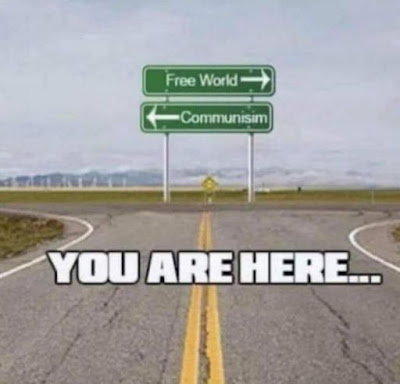
Stop Falling for the Either/Or Crap!

...Or so some people would have you believe....

It doesn’t make good sense to trust every aspect of life to government – any kind of government. Communism only turns into another kind of oligarchy, with party leaders on top taking the place of landed gentry and everyone else relegated to a peasant/worker class with few important rights. --But neither does it make good sense to trust every aspect of life to unregulated market forces. There are essentials in life, both biological and social, much too important to be left to unrestrained market forces. The only kind of economic “system” that makes sense is a mixed economy, with roles both for entrepreneurial markets, regulated where necessary, and government-run public institutions.


Note that I do not use the term “free market” for the ubiquitous either/or false dilemma so often posed. Why? Because what is meant by “free” when applied to market forces just is lack of regulation. We are asked to allow business to be as free as the wind, and if it whirls itself into a tornado or whips up a tsunami and destroys human lives in its path, well, we are told, that’s the price of “freedom.” No. I say no. That is the price of self-deception on the part of Americans who have bought into a dangerous theoretical fiction unleashed on the world by Milton Friedmann and confusing and destroying communities for decades.


Economists are theoreticians. I find it bitterly ironic that so many people who consider themselves “conservative” will reject evolution because it is a “only a theory” and then turn around and embrace an economic theory which has far less evidence for itself. And yet the untrammeled theoretical “free market” has become an article of faith for American conservatives, a plank almost religious (to judge by the fervor with which it is held), and certainly a litmus test for politicians, so that if a candidate voices the slightest support for any kind of regulation, that candidate is branded “socialist” or even “communist,” and conservatives run in fear, believing their “freedom” is in danger.


Bullshit! If all aspects of health, education, and banking were to be treated exclusively as unregulated businesses, with clinics, hospitals, schools, and investment groups run solely for profit and without any boundaries on their greed, the rights of American citizens to speak and organize and vote would count for very little. You don’t trust “government,” but you trust “corporations”? Really? With your life?


Would you do away with public libraries, public schools, public boards of health, and replace all of them with for-profit businesses, available only to paid subscribers, like cable TV? Would you close the government mint and throw American citizens on the stormy, uncertain seas of myriad “crypto-currencies” (digital “currencies” 100% dependent on huge, monster computers, with their huge, monster fans running 24/7 somewhere off in the countryside), an untested monetary abstraction that few even pretend to understand? 


A simpler example: A certain faction of our country seeks to “privatize” (i.e., sell to profit-seekers) the United States Postal Service, replacing it with anyone in the market who wanted to start up a company but would have no mandate to serve the entire country. Profitable areas could be cherry-picked, the rest underserved or not served at all. 


And note carefully here that “privatization” means more than letting business instead of government run something: it means selling off carefully constructed public goods that have been built and maintained for years with money from public taxes – not to those who paid the taxes for years (often generations) but to a private, profit-seeking organization or organizations. [Note: The United States Postal Service was government-funded until 1970. Since then, like county conservation district offices, it has had to pay its own way in the country, competing against private companies who do not have to serve every community.] Historic public good sold at fire sale prices? How can that be for the benefit of the public? How does that increase the “freedom” of citizens?


Those who would blind you with the false dilemma “socialism vs. freedom” rely on your not seeing that unrestricted “freedom” for corporate “persons” means seriously diminished real freedom for real persons, i.e., human beings. No one can own the air, and it cannot be restricted to a bounded place, so why should a corporation be allowed to poison it in order to make profits, and how does sacrificing environmental and human health to market forces increase our freedom? It does not. That is only one example.


I don't even want to say there are many shades of grey between black and white, and the idea of heads or tails on a coin is plain silly. It makes more sense and is truer to life to think of alternatives to either/or as a rainbow of possibilities.


The "road" of the future does not exist until we build it -- and in my imagination it is not one big superhighway but an interconnected network. Again, possibilities....


False dilemmas - Homework: Think about it. 


Saturday, October 3, 2015

Warning: More Than Nursery School Attention Span Required


What is “scientific”? I wonder if my friends and I see it the same way.
I was delighted by the first two paragraphs of Wendell Berry's letter published in October 22, 2015, issue of New York Review of Books (received in my p.o. box this morning) before I looked down to see his name, upon which my delight increased tenfold. Finishing his letter, I went on to read Edmund Phelps in what was billed as a reply, whereupon my delight vanished.
Berry's points, sufficiently clear that one need not possess a degree in economics to understand them, are that (1) agriculture is a huge part of the American economy and that (2) current industrial and chemical practices visited on the land are toxic and unsustainable. Nowhere in his so-called reply does Phelps address these points. Instead he leaps to a generalized defense of "modernity," as he defines it,dragging a string of red herrings across the path.
Phelps sees threats to free speech, in the university classroom and elsewhere. This is no answer to economists ignoring agriculture or to the current and widespread destructive practices of corporate-scale farming. And where is his evidence for the claim that free speech is "ever more limited"? Who in this country has been jailed recently for speech? What newspapers, magazines, and publishing houses have been shut down? As far as university classes go, administration guidelines to faculty probably have much more to do with the fact that higher education is now run more and more on a modern business model -- mustn't alienate "customers"! -- than with any fears of government censorship.
And does Phelps really find mandatory testing of new products an undesirable curb on ingenuity? Is this a scientific, "modern" view? Would he return us to the days of thalidomide on the market?
The general attitude of Phelps is one I have encountered before, often in individuals with backgrounds such as engineering. They seem to feel that whatever comes out of a laboratory is, by definition, "scientific" and, therefore, to be adopted without question. I find this view unscientific in the extreme. A more enlightened view of modern science is to recognize its necessary reliance on ceaseless experimentation and testing. Independent studies of agricultural practices point in a very different direction from corporate-subsidized studies. I recommend readers to the monthly magazine AcresUSA, "the voice of eco-agriculture," published since 1971.
If I were a cartoonist, I would draw a picture. Wendell Berry and the Acres people, along with all the organic farmers and CSA families I know, would be standing at the edge of a precipice, holding up big detour signs, while a river of lemmings, wearing t-shirts with slogans for GMOs, CAFOs, and agrichemicals would be running at them full-tilt, pushing them aside to leap to their doom. Sadly, if the lemmings succeed, the rest of us will not be left standing on the cliff but will be dragged along to our doom.
Surely, "the West's modern project" – that which Phelps takes himself to be defending against Wendell Berry and imaginary quashers of free speech -- can do better. All that's needed is objective and rigorous scrutiny of the evidence and a willingness to adapt. Is that not modern and scientific?


-- 


I posted the foregoing on Facebook, having modified somewhat a letter sent to NYRB editor. Facebook (for those few unacquainted with that bantering, slogan-ridden, wisecracking social media platform) does not generally offer high-level exchange of thought, but I did receive an insightful comment from one friend, who included this link. The bottom line is that as bad as things were before, they are worse since 1996 with the rollback of the Delaney Clause, a legislative protection in place since 1950 and now removed by Congress, with only one voice raised in protest. Read it and weep. For those who attention span has   already been overtaxed, here are a few highlights: 


"With the Delaney Clause dead on the floor of Congress, some 80 pesticides that were about to be outlawed as carcinogens will now remain in use. Call it the Dow-Monsanto bail-out bill, since these two companies make most of the chemical killers that were on the list to be banned."

“Chemicals go a long way in a small body,” Clinton said. He could have been more specific. The new law now ensures that when children eat strawberries, they will also be ingesting the deadly chemical residue left by benamyl, captan, and methyl bromide. The average apple and peach has eight different pesticides embedded in it. Grapes have six and celery five. Children get as much as 35 percent of their likely lifetime dose of such toxins by the time they are five."